Friday, October 24, 2008

How many UAW members will actually be working in 2010?

Friday, October 24, 2008

More buyouts will not help automakers shed more workers, Gettelfinger says

Louis Aguilar / The Detroit News

DETROIT -- United Auto Workers President Ron Gettelfinger said he didn't think another round of buyouts would help automakers shed more of their hourly work force but he deflected a question on whether the union is considering re-opening the landmark national labor contracts signed last year with the Detroit Big Three automakers.

"I'm not sure the value of a buyout at this point and time," Gettelfinger told reporters this morning at Detroit's Cobo Center, where the labor union president was honored by the Goodfellows charity organization. Gettelfinger reasoned that UAW-protected autoworkers who were in the position to leave their jobs would have taken one of the previous rounds of buyouts and early retirement offers and he didn't see the "effectiveness" of another round.

Gettelfinger acknowledged that he was in discussions with the Big Three automakers as they grapple with the immense impact of the global financing crisis and the worst auto sales market in 15 years, but he declined to provide details.

When asked whether he was discussing the possibility of re-opening last year's labor agreements, Gettelfinger responded: "Next question."

He was far clearer on protecting the independent health care trusts created for retirees.

Under the four-year labor contracts, Detroit's automakers are shifting retiree health care liabilities to the independent health care trusts, known as a Voluntary Employee Beneficiary Association, VEBA. The VEBA trusts are scheduled to begin operating Jan. 1, 2010, with about $30 billion of what ultimately will be nearly $52 billion in automaker contributions. The UAW has said in the past the money will last for 80 years.

"We do not want to open up VEBA," Gettelfinger said.

"That was one of the most difficult and challenging decisions I ever had to make," he said, referring to the fund's creation.

You can reach Louis Aguilar at (313) 222-2760 or laguilar@detnews.com.

© Copyright 2008 The Detroit News. All rights reserved.

Thursday, October 23, 2008

October 23rd, 2008

After the layoffs: Increased workloads stress out those left behind

Posted by Sam Diaz @ 12:13 pm

Jobcuts are never easy - and finding your name on the layoff list can be traumatic, especially this time of year. There's no disputing that.

But what about the folks whose names are not on the list, the ones who get left behind to pick up the workload slack? They certainly don't want to be complainers when the boss comes walking over to hand off the work that Mary or Joe was doing, before they were laid off. But, they were barely keeping up with their own workload before - and now there's more?

An increased workload - followed by the pace of new technology and office politics - are the leading causes of stress for IT workers today, according to a survey released by Robert Half Technologies. OK, I know what you're thinking: Too much work can be a good thing in today's economic climate. But it can also take a toll on productivity. Overstressed workers don't usually perform at their best and stressed-out workplaces can quickly erode morale, as well.

Robert Half Technologies, which asked the question as part of a larger survey that helps shape hiring forecasts, said some companies are bringing in IT folks on a contract basis to help with the workload. Many are also looking at training and professional development programs to help employees keep pace with technology. Most importantly, though, good managers open the lines of communication to keep employees motivated and ensure that priority projects stay on track.

The survey asked the question: Which of the following do you think is the greatest source of workplace stress for IT professionals? The responses were:

Sam Diaz is a senior editor at ZDNet. See his full profile and disclosure of

India's Tech Firms Unlikely to Elude Global Crisis

Lackluster Profits From Flagship Companies Suggest Sector Won't Dodge Global Crisis

India's leading technology companies -- the flagships of the country's economy -- doused hopes that they could escape from a spreading global financial crisis anytime soon.

"Our outlook is cautious in the near term given the extent of strain on the global economy," said Azim Premji, chairman of Wipro Ltd.. That pessimism comes despite a sharp weakening of the Indian rupee, which helps tech companies that earn most of their revenue overseas.

Under Indian accounting standards, Bangalore-based Wipro said net profit for the July-September period rose to 9.78 billion rupees ($200.2 million) from 8.24 billion rupees in the year-earlier quarter. ...


Monday, October 20, 2008

ob recruiting racketeers make a kill on no-go ban to Iraq

By Leon Berenger and Chandani Kirinde

Hundreds of Sri Lankans are risking their lives and making their way into war-torn Iraq to secure lucrative employment inside US military facilities while a helpless officialdom say there is little they can do as unscrupulous recruiting agents make millions of rupees out of this illegal operation.

Although almost daily groups of Sri Lankans are leaving these shores and heading for Iraq there is very little the authorities can do to stop it since their departure is done through legitimate channels.

While there are many who have found safe passage to Iraq, The Sunday Times spoke to several youth who were stranded at the Dubai International Airport in late September for more than two weeks since arriving there from Colombo. An agent of the local travel agency had promised they would be met on arrival by one of their agents in Dubai who would ensure their passage to Iraq. But for one week they were left all alone at the airport with no idea as to what would happen to them. When the agent finally met them, they were told it would take a few more days to travel to Iraq.
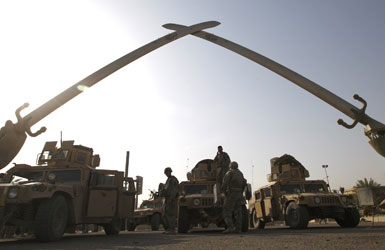
U.S. soldiers stand near the Swords of Qadisiyah monument in Baghdad. Many Lankans are employed in various US military facilities as janitors,
cleaners, mess boys, storekeepers, laundry hands and construction workers

As the men had run out of money they had to rely on the hospitality extended by the many Sri Lankan who work at the airport and those who pass through it to get their daily meals. There were 13 men in this group.

They had each paid Rs. 250,000 to a job agent in Armour Street, Colombo and were told they would be employed at US bases in Iraq and paid a monthly remuneration of US $550 but their dreams of finding lucrative employment had become a nightmare just two weeks after leaving the country. One of the men had been sent to Afghanistan, also to a US military base but after two months due to the poor working conditions, he had managed to find his passage back to Dubai and was awaiting a ticket to return home
The Government has banned sending Sri Lankans to Iraq for employment due to the security situation there and two agencies were raided earlier this year for doing so. But many registered travel agencies in the country continue to recruit persons but give no security guarantees.

"We have had many cases of Sri Lankans stranded in Iraq who have sought assistance from our missions in Jordan and Lebanon. But as we have almost no diplomatic representation in Baghdad now and no consular representation at all, it is difficult to assist them," an official of the Foreign Ministry who served till recently in the Sri Lanka Mission in Lebanon said.

The International Organization for Migration (IOM) had also reportedly helped more than 30 Sri Lankan workers flee Iraq since February 2007 after finding that they were being exploited and were living in deplorable conditions.

The lack of any records on how many Sri Lankans are employed in Iraq also makes it more difficult to trace their whereabouts when the need arises. Sri Lankans who had been stranded there and who had managed to contact Sri Lankan missions in neighboring countries had been repatriated with the assistance of the US military and the Iraqi government, the official said.

The bulk of Sri Lankans destined for Iraq first land in the United Arab Emirates (UAE) on so-called transit visas that are easily obtained and which are issued mainly to intended shoppers and tourists entering the desert nation. On arrival in the UAE the Sri Lankan workers are picked up by handlers, taken to a transit house where they are fed, given shelter and later taken to Iraq by road over the Kuwaiti border.

Thereafter they are found employment in various US military facilities as janitors, cleaners, mess boys, storekeepers, laundry hands and construction workers.

An average worker earns around $600 to 700 a month inclusive of food, accommodation, medical and even liquor and tobacco rations, something they will never get in any other West Asian country.
However, the workers are not allowed to leave the military base owing to the security situation and insurgents show no mercy for foreigners caught working for American interests. On completion of their contracts which vary from one to two years they are brought back to the UAE crossing the same desert borders from where they board a flight back to Colombo.

The passports do not contain immigration endorsements of Iraq or any other country except that of the UAE, their first landing point which indicates that they have not left the country at any time. Hence the UAE authorities have no objection in allowing them to exit the country.

US Embassy spokesman in Colombo Jeff Anderson when asked to comment on the employment of Sri Lankans in US military bases in Iraq declined to do so.

A Sunday Times investigation found that the main culprits behind this racket are the registered recruiting agencies who cleverly conduct their operations using middlemen/brokers who are paid a commission for their services.

Persons seeking employment in Iraq are charged anything between Rs. 200,000 to 250,000. This includes the airline ticket and other local expenses such as medicals, bureau taxes etc, the investigation revealed.

The agencies do not advertise or in any way publicise vacancies in Iraq, since the recruitment of workers for that country is outlawed. However, they use other means of getting their message across.
For example a long-time established recruiting agency operating in Colombo has put up a long list of vacancies in the UAE, but in fact the jobs are actually available in Iraq.

The agency it is alleged discloses this to a prospective job hunter only once they are satisfied that the person is genuine and is seeking to work in Iraq. Thereafter the two parties discuss the other details such as payments, day of departure etc.

The Sri Lanka Bureau for Foreign Employment (SLFEB) is fully aware of the Iraqi operations, but for reasons perhaps known only to them have opted to maintain a lukewarm attitude if not ignoring the errant agents altogether.

SLFEB Deputy General Manager L.K. Ruhunuge said although they were aware of the recruitment for Iraq it was difficult to carry out a crackdown since the persons were leaving the country through legitimate channels and posessed valid visas-transit, visit or any other.

He said that two agencies that were found to be involved in the illegal recruitment have had their operations suspended, but apart from that there have been no complaints from people who have taken up employment in Iraq.

Another frightening aspect is that no one is prepared to take responsibility for those taking up work in Iraq and in the event of a tragedy, matters could become complicated, admits Mr. Ruhunuge.

So far there have been two deaths of Lankans in Iraq. In one a worker was killed when a missile hit an oil storage dump and the other was caused by an industrial accident, Mr. Ruhunuge said.

He added that investigations into an errant recruitment agency could commence only if there has been a complaint, but apart from that there was little the Bureau could do.

These words will no doubt be music to the ears of the recruitment agencies, their so-called brokers, handlers and every one involved in this racket.

Big promises but empty pockets

Driven by economic hardship, S.V.Gamini of Kalutara was among a group of 21 Sri Lankans who left for Iraq in December last year with the prospect of coming home with enough money to lead a more comfortable life than the present one.

He borrowed money to pay a job agency in Borella Rs. 230, 000 to secure a job and left on December 14 last year for Dubai along with several others. On their arrival, they were met by a contact of the Sri Lankan agent and put on a flight to Iraq. The group was split into two and put to work in two US military bases, mainly as labourers. There were 16 Sri Lankans working with Gamini.

"We were given the promised monthly salary of US $ 550 and had enough food and adequate accommodation," he said. Gamini worked there for ten months and decided to leave when he felt that the security situation was getting dangerous." A few days before we left, a mortar fell into an adjoining room where we were working It was frightening," he said.

Gamini was also in poor health by now and said he wanted to leave prior to the end of his one year contract. He and four others were allowed to go but their two months salary was deducted to pay for their air ticket which cost around Rs100, 000. When they arrived at the Sharjah airport, they had to pay an additional US $ 100 as visa fee and although they were promised free transport from Shajarh to Dubai, the men had to pay another US $ 80 to travel by taxi to the Dubai airport from where they boarded a flight to Colombo.

However, two of the men were detained in Shajarh as their passports had expired. "Although I went there with high hopes, I was not able to save any money. Job agencies charge us so much to send us to Iraq but they don't keep to their side of the bargain," he lamented.

The New York Times
Printer Friendly Format Sponsored By


October 21, 2008

Iceland Poised to Get $6 Billion Rescue Package

WASHINGTON — The International Monetary Fund, along with several Nordic countries and Russia, is poised to announce a $6 billion rescue plan for Iceland, whose once-booming financial system collapsed early this month.

Iceland would receive about $1 billion in emergency cash from the monetary fund, and the balance from Norway, Sweden, Denmark and Russia, according to an official of the fund who asked not to be identified because the formal announcement had yet to be made.

The plan for Iceland was the latest extraordinary rescue effort led by governments, central banks and multilateral institutions to address the global credit crisis and its fallout.

Detailed terms of the plan were not immediately known.

Typically, such a rescue organized by the monetary fund would depend on the recipient government taking stringent measures to restore fiscal and monetary stability. In the case of the fund's deal with South Korea in 1997, during the Asian financial crisis, the government in Seoul complained bitterly that the harsh medicine made matters worse before they got better.

A person briefed on the situation said that Iceland's cabinet, led by Prime Minister Geir H. Haarde, planned to discuss the rescue package at a meeting on Tuesday. Mr. Haarde said last week that a decision on whether to accept the fund's help, and its conditions, would be made by Thursday.

The country's industry minister, Oessur Skarphedinsson, told Bloomberg News that a deal was close, and that Japan might also take part in it.

"It's clear from our diplomatic contacts that if and when an agreement is made between the I.M.F. and Iceland, then our neighbors would be quite willing to sail in their wake," Mr. Skarphedinsson told the news agency from Reykjavik. "We, in fact, have confirmation of what I would label quite generous lending facilities."

Iceland has been in dire need of financial help since the government found itself having to take control of the last of the country's three major banks, Kaupthing. Along with the other two banks, Landsbanki and Glitnir, Kaupthing was brought down by the weight of debts, denominated mainly in foreign currency, that it was unable to refinance.

Analysts have said that a rescue coordinated by the monetary fund had become the only practical path out of the crisis for Iceland, which already faces the prospect of a deep recession. But Iceland's leaders, worried about the stigma that attaches to countries that have to be rescued by the fund, had sought to exhaust all other options first.

Even so, the fund sent a team to Iceland early this month and the decision by the fund to approve a rescue plan for Iceland appeared to be the breakthrough that allowed other central banks to join in supporting the country.

The crisis struck Iceland quickly and hard, leaving the country and its financial system essentially bankrupt. After the government took over the banks and shuttered the stock exchange, trading in the krona, the Icelandic currency, ceased, and without a viable, exchangeable currency, Iceland had no mechanism to affect inflation or interest rates, both of which had risen to double-digit rates before the crisis.

The monetary fund-led rescue deal for Iceland was first reported on Monday by the Web site of The Financial Times.

The recent events represented a sharp reversal in Iceland's fortunes. The country's banks had expanded aggressively in the last decade, and though they largely stayed away from troubled mortgage securities, the global tightening of credit this year left them unable to finance their debts, which are largely denominated in foreign currencies.

Some Icelandic authorities have suggested that once matters stabilize, the country should give up having an independent currency, and instead either adopt the euro outright or peg the value of the krona firmly to that of the euro.

Another possibility, rejected in the past, is to join the European Union as a member nation, a proposal that Icelandic conservatives have opposed. Still, Olli Rehn, the union's commissioner for enlargement, told Agence France-Presse on Monday that Iceland would not find it difficult to be admitted to the union.

"Iceland is clearly a democratic European country," which has "already negotiated perhaps two-thirds" of the criteria needed to join the 27 current members, Mr. Rehn told the agency. "This means that, were Iceland to pose its candidature, we could quickly complete the negotiations."

Ukraine and Pakistan are also among countries discussing rescue plans with the monetary fund.

Eric Pfanner contributed reporting from London.


Friday, October 17, 2008

Print | Close this window

Russia not yet ready to lend to Iceland

Fri Oct 17, 2008 3:57pm EDT

By Patrick Lannin and Toni Vorobyova

REYKJAVIK/MOSCOW (Reuters) - Russia is not yet convinced it should make a loan to Iceland to help dig it out of a financial crisis, a Russian source said on Friday.

But as the island ran down more of its meager foreign reserves, Iceland said it hoped its biggest bank, Kaupthing, would next week be able to re-open its Luxembourg branch to pay back Belgian and Luxembourg depositors.

Two weeks after a banking collapse destroyed the value of its economy and currency, Iceland has still to decide whether to go to the International Monetary Fund (IMF) for help.

Prime Minister Geir Haarde said a decision was still expected within a week. In the meantime, talks with Russia this week on a loan have not yet led to a deal.

"At the current moment, we do not yet have enough reasons to give them credit," a senior Russian government source told Reuters. "We did not refuse. We are continuing the talks."

The island of 300,000 people is the most serious state victim of the global credit crunch. But banking problems in Ukraine and Hungary have also sent those countries scrambling to the IMF and European Central Bank amid fears they might be next.

Billions of dollars in foreign savings are locked up inside Iceland's banks, attracted by some of the highest interest rates in Europe. One such group is people from Belgium and Luxembourg.

Belgian Prime Minister Yves Leterme met Haarde, to discuss these depositors and Haarde said Iceland hoped the receiver running Kaupthing could re-open the Luxembourg branch.

"If that is the case then it looks like the problems with respect to the depositors will be solved within a relatively short period of time," Haarde told a news conference.

Leterme said he hoped a solution could be found by next Tuesday to bring the bank back into operations.

Leterme said no loan to Iceland had been discussed.

OFFERING BARS, VOLCANOES, AIRBASE?

But with banking debts several times its gross domestic product, Iceland needs money badly.

Analysts have also wondered what price Russia -- suffering its own economic problems and increasingly at odds with the West in the aftermath of the Georgia war -- might exact.

Iceland has repeatedly said it will not offer Russia use of a former U.S. airbase but one analyst said Russia might be keener on a deal if Iceland was successful in being elected to a temporary post on the U.N. Security Council.

But Iceland lost out to Turkey and Austria for the two European seats on offer on Friday, apparently in part because of its financial crisis, gaining only 87 votes from the 192 member assembly.

Facing a brutally hard landing from years of prosperity, Iceland this week slashed interest rates and raised controls to stimulate the economy and prevent capital flight.

The central bank has also been selling foreign currency to local banks -- whose domestic assets have been nationalized -- at almost half the rate at which the crown has been trading internationally. Firms are only allowed foreign exchange for essential purchases such as food and fuel.

"Effectively, you have a dual exchange rate which isn't that unusual in this sort of case," said one analyst, asking not to be named to avoid damaging commercial relationships.

"What the government is doing is giving away foreign exchange locally at much cheaper than the market rate."

Meanwhile Iceland hopes its currency collapse will attract more tourists drawn by its nightlife, spas and volcanoes. For now bars and restaurants along Reykjavik's main street are doing a roaring trade -- perhaps in part because of the crisis.

"Actually, when people get depressed they drink more," said bar manager Friesteinn Gislasson. "The crisis has not hit us so much so far."

(Writing by Peter Apps; Editing by Matthew Jones)

© Thomson Reuters 2008. All rights reserved. Users may download and print extracts of content from this website for their own personal and non-commercial use only. Republication or redistribution of Thomson Reuters content, including by framing or similar means, is expressly prohibited without the prior written consent of Thomson Reuters. Thomson Reuters and its logo are registered trademarks or trademarks of the Thomson Reuters group of companies around the world.

Print | Close this window

Russia bank bailout bill hits $5.5 bln; queue grows

Fri Oct 17, 2008 1:13pm EDT

By Dmitry Zhdannikov and Dmitry Sergeyev

MOSCOW, Oct 17 (Reuters) - Russia has already spent $5.5 billion bailing out banks as it seeks to prevent panic spreading to the streets and triggering a run on banks, but the queue of needy institutions is growing fast.

The government will have to plan subsequent moves carefully and prioritise how it now doles out its not-unlimited resources.

Wary depositors have lost their savings several times in post-Soviet history, and a false move by the state could trigger panic that could cripple Russia's still nascent financial sector for years.

"While we expect further failures among small banks, we believe the panic could quickly intensify if the authorities allow a deposit-rich bank to go under," analysts from Unicredit Aton said in a research note.

On Friday, state bank VEB said it would buy mid-sized bank Globex, which had acute liquidity problems, for a symbolic amount. Globex would become the fourth bank among Russia's top 50 to be effectively nationalised by the state in the past weeks.

"More then 100 banks are looking for buyers. There will be a very big reshuffle," a senior Russian banker said this week.

This month the government has already bailed out three mid-sized banks, Svyaz, KIT Finance and Sobinbank.

"Just as we did with Svyaz Bank, we will take the whole bank and start helping it, partly with money that the Central Bank will deposit with us," VEB's chairman Vladimir Dmitriyev told Russian agencies.

While the purchase price of 5,000 roubles may be seen symbolic, Dmitriyev said the state will deposit $2 billion with VEB to help rescue Globex.

That brings the total rescue package for the banking sector to over $5.5 billion as the the central bank has already provided over $2 billion to VEB to help Svyaz Bank.

The rescue of Sobinbank by a banking unit of gas monopoly Gazprom (GAZP.MM: Quote, Profile, Research, Stock Buzz), Gazenergoprombank, cost another $500 million. Gazprom's other bank, Gazprombank, opened a $1.14 billion credit line to KIT Finance.

"There are several other banks waiting for their turn", a high-level government source said late on Thursday.

Russia has over 1,300 banks and authorities have said a crisis could help reduce the number to a more manageable level as many of the institutions, created in the 1990s as pocket banks of large corporations, have outlived themselves.

"The news (about Globex) once again highlights the authorities' commitment to support banking system stability, with a clear focus on top 50 banks," said David Nangle, analyst at Renaissance Capital.

The banking sector is due to get $36 billion as part of the state's total $210 billion rescue package for the financial sector with the bulk of it due to flow via VEB, and state-run listed behemoths Sberbank (SBER03.MM: Quote, Profile, Research, Stock Buzz) and VTB (VTBR.MM: Quote, Profile, Research, Stock Buzz)

The picture among the top 50 is highly varied, as some can comfortably rely on shareholders with oil, steel or chemical assets, although some owners have been withdraw money to pay on other obligations.

Western banks, which have expanded aggressively in Russia in the past years, betting on high revenues amid record economic growth levels, have also pledged support for their branches, although many face troubles at home.

Those which specialised in retail lending, mortgage or heavily credited the real estate sector through cheap Western borrowings are in the risk zone.

Bankers note that Russians unfailingly continue to pay mortgage and retail loans, and continue to deposit money with state banks.

But nerves are fraying, even though the central bank has kept the rouble rate stable by injecting billions of dollars to support the currency on the forex market.

"People are lost. I see some clients ending their term deposits early and putting money in safe deposit boxes. The next day they convert roubles into dollars. On the third day, they convert them into euros and open a new deposit account. It is not yet panic but it is close," a top banker said. (Reporting by Dmitry Zhdannikov and Dmitry Sergeyev; editing by Hans Peters)

© Thomson Reuters 2008. All rights reserved. Users may download and print extracts of content from this website for their own personal and non-commercial use only. Republication or redistribution of Thomson Reuters content, including by framing or similar means, is expressly prohibited without the prior written consent of Thomson Reuters. Thomson Reuters and its logo are registered trademarks or trademarks of the Thomson Reuters group of companies around the world.